

A piece of an important and largely forgotten chapter of Overstrand’s history has been brought to light with the unveiling of a plaque commemorating the people who lived and died at the former Hemel-en-Aarde Leper Institute.
For too long, the stories of the men, women and children who lived, suffered and died in this valley have been quiet whispers in our history. Many lie buried in nearby soil in graves whose markers have long since faded.
This plaque changes that.
Table of Contents
The Plaque is a Reminder
It stands as a physical anchor of remembrance. It reminds every traveller who drives through this valley that this ground carries a deep history. It honours the resilience of the patients who built a life in difficult circumstances, as well as the extraordinary legacy of compassion left by those who cared for them.
The moving ceremony took place on Monday, 28 September 2026, at Plaaskombuis on the farm Vrede in the Hemel-en-Aarde Valley, close to the site where the hospital once stood.
The Hemel-en-Aarde Leper Institute operated from 1817 to 1845. People suffering from leprosy were brought to the isolated valley, separated from their homes, families and livelihoods. The Moravian Mission of Genadendal took responsibility for the care of the residents from 1823, following the construction of the hospital, and continued this work until the Institute closed and the remaining patients were moved to Robben Island in 1845.
This plaque commemorates the afflicted inmates who lived here in abject misery, and to those who cared for them. The Colonial Government of the time bought the farm Attaquaskloof and established the Institute here in 1817.
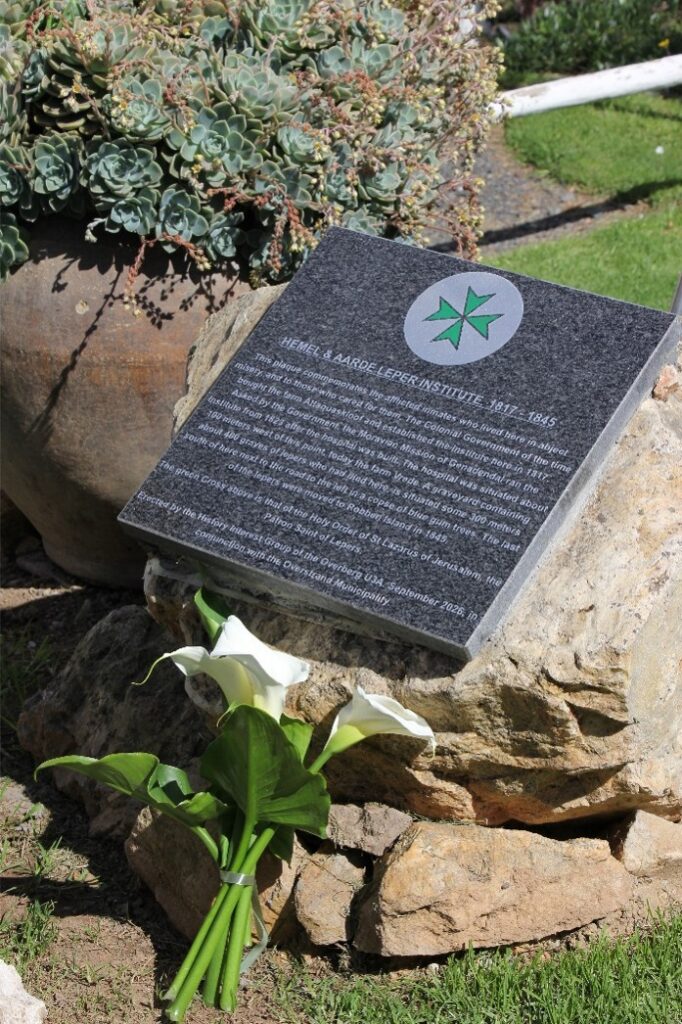
Asked by the Government, the Moravian Mission of Genadendal ran the Institute from 1823 after the hospital was built. The hospital was situated about 100 meters west of this point, today the farm Vrede. A graveyard containing about 400 graves of lepers who had died here, is situated some 300 meters south of here next to the road to the left in a copse of blue gum trees. The last of the lepers were moved to Robben Island in 1845.
The green Cross above is that of the Holy Order of St Lazarus of Jerusalem, the Patron Saint of Lepers.
Erected by the History Interest Group of the Overberg U3A. January 2025, in conjunction with the Overstrand Municipality.
Story of humanity
The history is difficult, but it is also a story of humanity.
It was therefore especially meaningful that the plaque was unveiled by Reverend Godfrey Cunningham of the Moravian Church in Genadendal. His presence brought a special connection between the Moravian community of today and the missionaries who cared for the residents of the Institute almost two centuries ago.
In his address, Rev Cunningham reflected on the contrast between the beauty of the Hemel-en-Aarde Valley today and the suffering once experienced in here. He spoke of the people who were isolated here, but also of the compassion shown by the Moravian missionaries who chose to serve them and helped bring dignity, community and care to their lives.
He reminded those gathered that the plaque is more than a historical marker. It is a lasting reminder of the people who lived here and of the lessons their story holds for us today – to meet illness with empathy rather than isolation, and to replace stigma with understanding.
Unveiling
Reverend Godfrey Cunningham of the Moravian Church in Genadendal unveiled a plaque commemorating the people who lived and died at the former Hemel-en-Aarde Leper Institute. He reflected on the long history of leprosy, saying that since biblical times, it had been one of the most dreaded and misunderstood diseases in the world. Driven by fear of infection and societal stigma, the colonial government established the valley as a place of isolation.
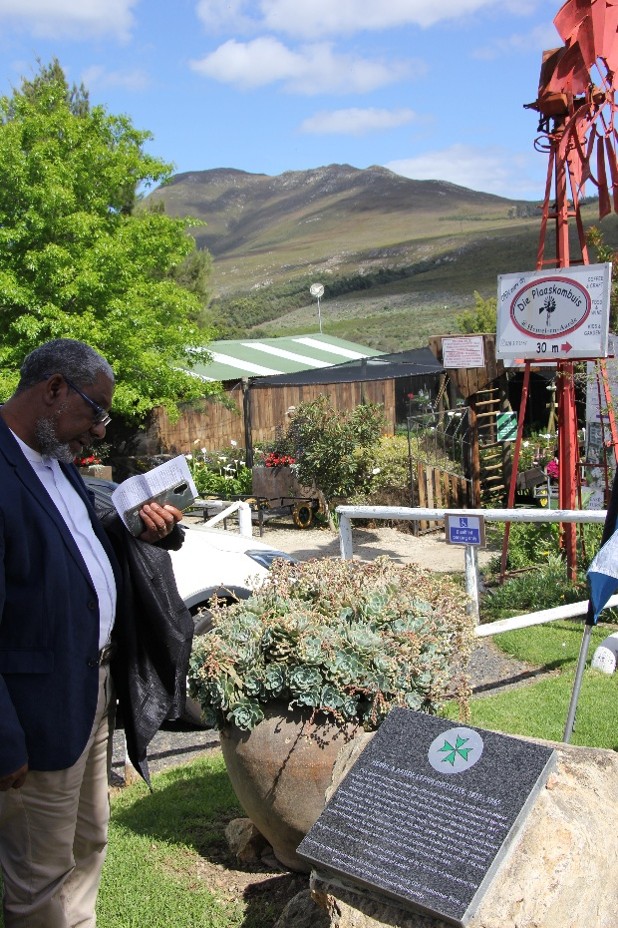
Yet, he said, the valley did not only witness suffering – it also witnessed profound humanity. Moravian missionaries voluntarily chose to move into the valley. They did not come out of medical obligation, but out of compassion, a principle deeply rooted in the theology of the Moravian Church.
The Plaque States
“This plaque commemorates the afflicted inmates who lived here in abject misery, and those who cared for them.”
It records that the hospital was situated approximately 100 metres west of the plaque, on what is today the farm Vrede, and that a graveyard containing about 400 graves of people who died at the Institute is situated further south.
The plaque also carries the green Cross of the Holy Order of St Lazarus of Jerusalem, the patron saint of people affected by leprosy.
Support From Farm Owners
The owners of the farm Vrede and Plaaskombuis, Nita and Jadri Lötter, generously supported the initiative and made the site available for this memorial. Their contribution helped create a fitting place where this history can be remembered and shared with future generations.
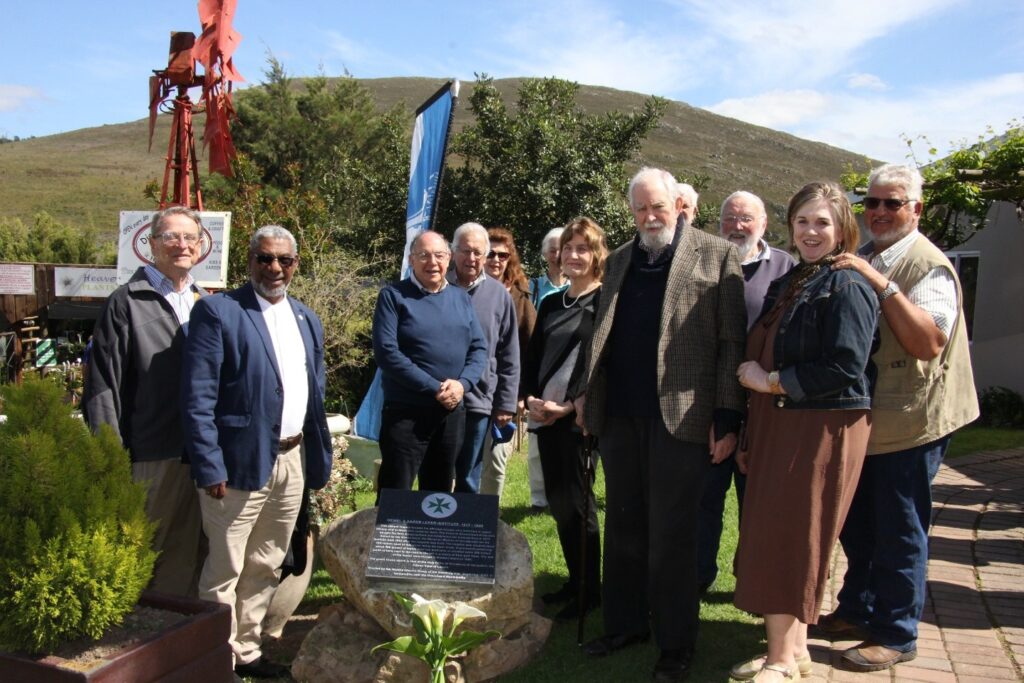
Pictured here are members of the History Interest Group of U3A Overberg, together with Reverend Godfrey Cunningham of the Moravian Church in Genadendal, who unveiled the commemorative plaque. Representatives from neighbouring farms, including Volmoed, also attended. The owners of Vrede and Plaaskombuis, Nita and Jadri Lötter, generously supported the initiative and made the site available for the memorial, helping ensure this history is remembered by future generations. The plaque was erected by the History Interest Group of U3A Overberg, in conjunction with the Overstrand Municipality, to commemorate those who lived and died at the former institute
Surrounded by the beauty for which the Hemel-en-Aarde Valley is known today, the gathering offered a poignant reminder that beneath its vineyards and celebrated landscapes lies a story of suffering, compassion, resilience and human dignity.
The History Interest Group of U3A Overberg is to be congratulated for ensuring that this chapter of local history is no longer a quiet whisper.
Those who lived here are no longer forgotten.