

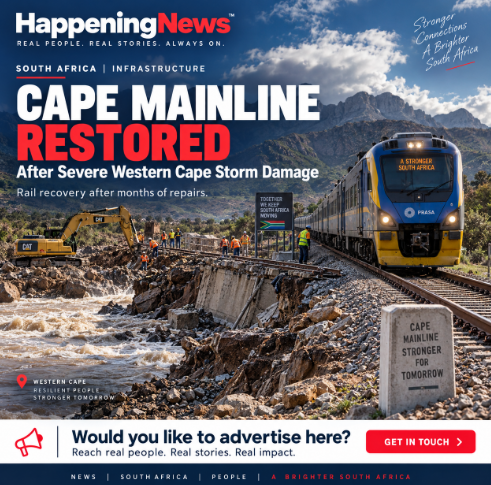
The Cape Mainline has been fully restored after severe storms, flooding and major washaways caused extensive damage to the strategic Western Cape railway earlier this year.
Transnet Rail Infrastructure Manager (TRIM) confirmed on Friday, 4 September 2026, that recovery and reconstruction work on the line had been completed.
The announcement marks an important milestone following months of repairs after the devastating May weather systems damaged railway infrastructure in the Western Cape and Karoo.
The Cape Mainline is not simply another railway. It forms an important freight connection between Cape Town and South Africa’s inland economic network, carrying containers, agricultural produce, industrial goods and minerals between the Port of Cape Town and other parts of the country.
Table of Contents
What Happened to the Cape Mainline?
Heavy rainfall, strong winds and flooding struck parts of the Western Cape on 11 and 12 May 2026.
According to TRIM, railway infrastructure was damaged at seven locations.
Five of the affected sites were in the Worcester area, while two major washaways occurred around Leeu-Gamka in the Karoo.
The scale of the destruction meant sections of the Cape Mainline had to remain closed for more than two months while repair teams worked to make the railway safe again.
The work was considerably more complicated than simply replacing damaged rails.
Recovery teams had to reconstruct sections where the underlying rail formation had been washed away, restore supporting infrastructure and track structures, repair overhead electrical equipment and replace mast poles damaged during the storms.
1. Diesel Trains Returned First
One of the first major breakthroughs came on 31 July 2026, when the Cape Mainline reopened for diesel-hauled trains.
This allowed rail traffic to begin returning while teams continued working on electrical infrastructure.
The reopening was particularly important because of the line’s role as a mixed-freight corridor connecting the Western Cape with South Africa’s inland rail system.
For businesses relying on rail transport, every improvement to the route helps restore another part of the logistics chain connecting farms, factories, mines and businesses with the Port of Cape Town.
2. Electric Trains Returned in August
The second important milestone was reached during August, when electric train operations resumed.
Before electric locomotives could return, damaged overhead track equipment had to be reinstated and commissioned.
TRIM has now confirmed that this work has been completed, allowing the line to return to full electric operations.
TRIM Chief Executive Moshe Motlohi said the reopening demonstrated the organisation’s commitment to operating a safe and reliable railway network while responding to infrastructure damage caused by extreme weather.
He also credited the teams and external stakeholders involved in the recovery operation.
3. The Damage Was Part of a Much Larger Western Cape Disaster
The destruction of the Cape Mainline formed only one part of the enormous damage caused by the May storms.
The Western Cape Government later estimated the preliminary cost of weather-related damage across the province at approximately R9.1 billion.
Agriculture alone was estimated to have suffered more than R5.2 billion in losses, while damage to transport infrastructure was estimated at just under R2 billion.
Those figures did not refer specifically to the Cape Mainline, but show the scale of the disaster within which the railway damage occurred.
The provincial government reported that approximately 231,000 people were affected, more than 22,000 houses were damaged, and more than 230 roads were affected by the severe weather.
Eleven fatalities had also been reported in the province when the preliminary assessment was released in June.
Areas including Worcester and the Cape Winelands were among those severely affected.
During the height of the storm, flooding, fallen trees, electricity outages and damaged roads caused widespread disruption across several Western Cape districts.
Why the Cape Mainline Matters
Restoring the railway is important well beyond the rail industry.
The Cape Mainline connects the Port of Cape Town with the country’s inland rail network and is used to transport containers, agricultural products, minerals and industrial goods.
A dependable railway network can also reduce pressure on South Africa’s roads by allowing larger quantities of freight to move by rail instead of truck.
For the Western Cape in particular, the connection is important to industries that need reliable access between production areas, inland markets and the port.
The storm damage therefore demonstrated how extreme weather can have consequences far beyond the immediate flooded area.
A washed-away section of railway in the Karoo or Cape Winelands can disrupt a logistics route extending hundreds of kilometres across the country.
Building Infrastructure That Can Withstand Future Storms
The completion of the Cape Mainline repairs is positive news, but the May disaster has also renewed questions about the resilience of South Africa’s infrastructure as severe weather events damage roads, railways, power infrastructure and communities.
Extreme weather and infrastructure resilience have become increasingly important issues across the Western Cape. HappeningNews recently also looked at the stability of Cape Town’s water system and the measures in place to protect essential services. Read more: Cape Town’s Water Supply Remains Stable.
Western Cape Premier Alan Winde said after the May storms that rebuilding would need to take future climate-related disasters into consideration and that infrastructure should be rebuilt stronger where possible.
That challenge will continue long after the immediate repair work is finished.
For Transnet, however, the latest milestone means a strategically important railway has returned to operation after months of difficult reconstruction.
Diesel trains returned in July, electric services followed in August, and Transnet has now formally confirmed completion of the recovery.
For the Cape Mainline, it represents a significant return to normality after one of the Western Cape’s most damaging periods of severe weather in recent years.
Sources
The restoration details are confirmed by the South African Government News Agency and Transnet reporting released on 4 September.