
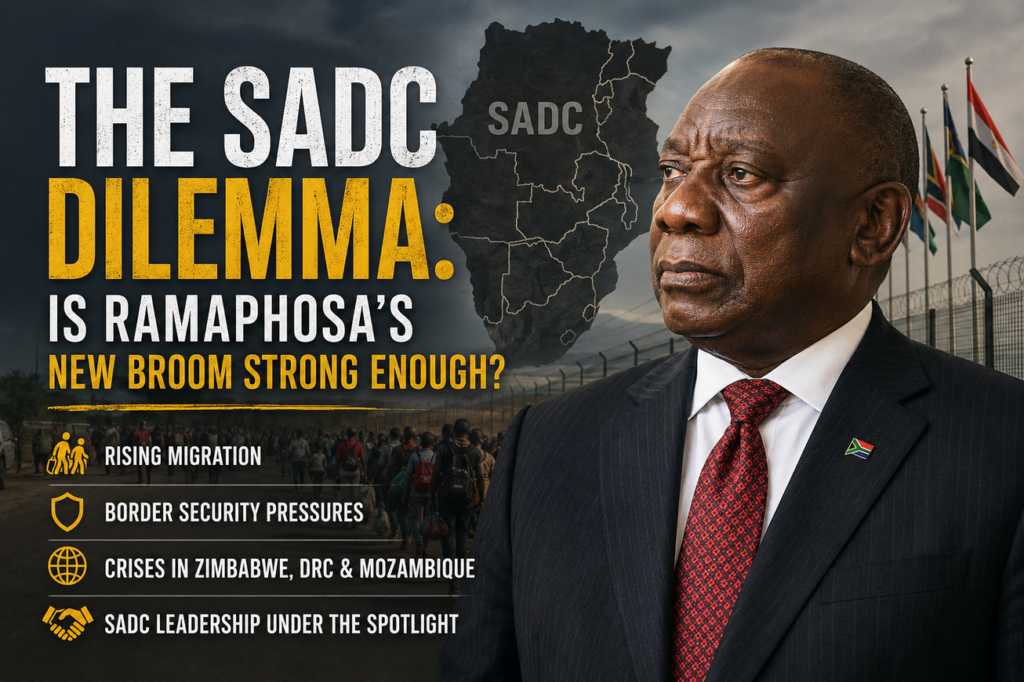
Is Ramaphosa’s new SADC leadership strong enough to tackle Southern Africa’s migration, security and regional stability challenges?
South Africa finds itself at a critical crossroads over regional migration, border security and diplomatic leadership as President Cyril Ramaphosa takes over the 2026–2027 chairpersonship of the Southern African Development Community (SADC).
The timing could hardly be more challenging. Migration pressure, border management, regional conflicts and economic instability are placing renewed focus on how SADC responds to problems that increasingly cross national borders.
With migrants returning from South Africa to neighbouring countries, including Zimbabwe and Malawi, pressure is mounting on borders while political and security crises continue across the region.

Ramaphosa’s new position gives him an opportunity to influence the direction of Southern Africa. But it also
places decades of unresolved regional challenges firmly on his agenda.
The question is whether Ramaphosa can bring a genuine “new broom” to SADC — or whether the organisation will continue relying on diplomatic consensus when stronger regional action is needed.
Can Ramaphosa Change SADC’s Approach to Migration?
For years, SADC has faced criticism over what some observers describe as a culture of quiet diplomacy, particularly when member states experience political instability, governance problems or security crises.
Ramaphosa now faces a difficult balancing act.
On one side is SADC’s commitment to regional economic integration, cooperation and the movement of people. On the other is South Africa’s growing concern over undocumented migration, pressure on public services, border management and domestic security.
The challenge will be finding a regional approach that protects legitimate migration and economic cooperation while also ensuring that member states take responsibility for effective border management and national security.
This is where Ramaphosa’s leadership will be tested.
The Zimbabwe Crisis and Regional Migration
The situation in Zimbabwe remains closely linked to migration patterns in the region.
Economic pressures, unemployment and political uncertainty have contributed to Zimbabweans seeking opportunities beyond their borders, with South Africa remaining a major destination.
But migration cannot be viewed in isolation.
If economic and political instability continues in countries sending large numbers of migrants southwards, South Africa will continue dealing with the consequences.
That raises a bigger question for SADC: Should regional leaders focus more aggressively on solving the problems that drive migration, rather than simply managing the movement of people once they reach the border?

Conflict in the DRC and Mozambique
The challenges facing SADC extend far beyond migration.
Conflict in the eastern Democratic Republic of the Congo (DRC) and the security situation in northern Mozambique continue to threaten regional stability.
These crises demonstrate why South Africa cannot deal with migration and border security as purely domestic issues.
Instability in one SADC member state can quickly have consequences for its neighbours through migration, humanitarian pressures, trade disruption and security concerns.
For Ramaphosa, the challenge is therefore much bigger than securing South Africa’s borders.
He needs to help strengthen the region at its source.
Border Security Versus Regional Integration
South Africa’s position within SADC creates an uncomfortable contradiction.
The country needs regional trade, investment and cooperation. At the same time, it faces intense domestic pressure to strengthen its borders and address concerns around undocumented migration.
A successful SADC strategy cannot simply mean opening borders wider, nor can it mean treating every migrant as a security threat.
The region needs better cooperation, stronger border systems, reliable documentation and coordinated immigration policies.
Most importantly, member states need to recognise that regional integration only works when countries collectively uphold their responsibilities.
South Africa is already pursuing stronger migration management and border reforms, including improvements to border infrastructure and immigration enforcement.
The question is whether these domestic measures can be matched by stronger regional cooperation.
Will Ramaphosa Deliver a “New Broom”?
As SADC chair, Ramaphosa is now positioned to play a leading diplomatic role in addressing some of Southern Africa’s most difficult challenges.
In the SADC migration crisis, his success should not be measured by ceremonial speeches or diplomatic statements.
It should be measured by whether SADC becomes more willing to confront difficult issues, demand accountability from member states and act decisively when regional crises threaten stability.
That includes addressing the root causes of migration, supporting meaningful solutions to regional conflicts and helping South Africa find a sustainable balance between border security and regional economic integration.
For South Africans, the stakes are particularly high.
The question is no longer simply whether Ramaphosa can lead SADC.
It is whether he can use the opportunity to change the way SADC responds to the region’s biggest challenges.
A New Broom or a Feather Duster?
The SADC migration crisis raises one fundamental question: Is Ramaphosa’s new SADC leadership strong enough to sweep away decades of diplomatic complacency?
Or will the organisation continue protecting the status quo in the name of regional solidarity?
Southern Africa is facing too many interconnected challenges for another period of diplomatic hesitation.
Ramaphosa has the broom.
Now the region will be watching to see whether he actually uses it.
Sources
SADC Secretariat | DIRCO | SAnews | SABC News | African Arguments | OkayAfrica | Koedoe App