South Africa Israel ICJ Case proceedings have become one of the most closely watched international legal disputes arising from the war in Gaza.
South Africa formally approached the International Court of Justice (ICJ) on 29 December 2023, alleging that Israel was violating its obligations under the Convention on the Prevention and Punishment of the Crime of Genocide in relation to Palestinians in Gaza.
Israel strongly rejects the genocide allegation and argues that its military campaign followed the Hamas-led attacks of 7 October 2023 and forms part of its right to defend its citizens and secure the release of hostages.
More than two years after the case began, the legal process is still underway. Importantly, the ICJ has not delivered a final judgment finding that Israel committed genocide.
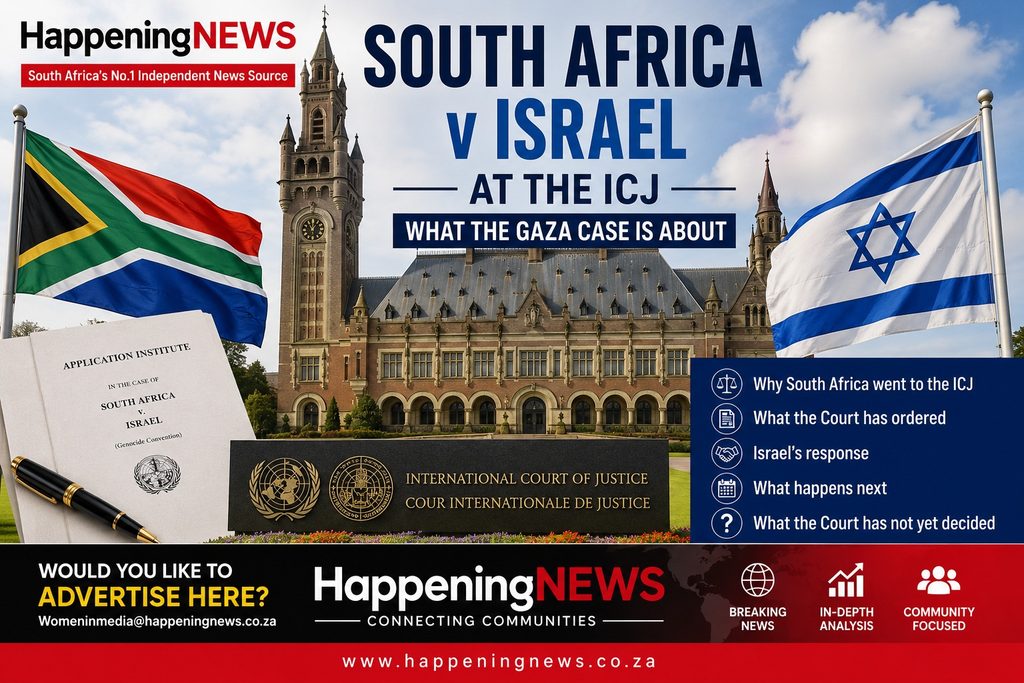
The South Africa Israel ICJ Case has drawn global attention because it tests how the Genocide Convention applies during an ongoing armed conflict.
Here are seven important facts readers should understand.
Table of Contents
1. Why did South Africa take Israel to the ICJ?
Understanding the South Africa Israel ICJ Case also requires distinguishing the ICJ from the International Criminal Court, which deals with criminal responsibility of individuals.
The South Africa Israel ICJ Case began when South Africa filed an application against Israel under the Genocide Convention.
South Africa argues that Palestinians in Gaza constitute a protected group under the Convention and alleges that Israeli conduct during the war violates obligations imposed by the treaty.
The case followed the 7 October 2023 Hamas-led attacks in Israel and Israel’s subsequent military campaign in Gaza.
South Africa asked the ICJ not only to consider the underlying allegations but also to issue urgent provisional measures intended to protect rights while the much longer main case was being decided.
2. What exactly is the ICJ?
The International Court of Justice, based at the Peace Palace in The Hague, is the principal judicial organ of the United Nations.
In this case, it is dealing with a dispute between two states: South Africa and Israel.
This is different from the International Criminal Court (ICC).
The ICJ determines legal disputes involving states. It does not conduct criminal trials of individual political leaders or military commanders in this case.
That distinction is important when following reports about international legal action relating to Gaza.
3. Has the ICJ ruled that Israel committed genocide?
No.
This is one of the most important points when reporting on the South Africa Israel ICJ Case.
The ICJ’s January 2024 order did not make a final finding that genocide had occurred.
At the provisional-measures stage, the Court found that at least some of the rights claimed by South Africa under the Genocide Convention were plausible, including the right of Palestinians in Gaza to be protected from acts of genocide.
The Court therefore ordered several temporary measures while the case continued.
Provisional measures are designed to preserve rights and prevent irreparable harm before a final ruling. They do not prejudge the eventual outcome of the case.
4. What has the Court ordered Israel to do?
The ICJ has issued several sets of provisional measures.
In January 2024, the Court ordered Israel, among other things, to take measures within its power to prevent acts falling within the Genocide Convention, prevent and punish direct and public incitement to genocide, enable urgently needed humanitarian assistance and preserve relevant evidence.
Israel was also required to report to the Court on steps taken to implement the order.
In March 2024, as humanitarian conditions deteriorated, the Court ordered additional measures relating particularly to the provision of food, water, medical care, fuel and other urgently needed humanitarian assistance.
The Court issued further measures in May 2024 concerning Rafah. These included ordering Israel, under specified conditions linked to the Genocide Convention, to halt military action in Rafah that could inflict conditions of life capable of bringing about the physical destruction of the Palestinian group in whole or in part, maintain the Rafah crossing for humanitarian assistance and enable access for UN-mandated investigative bodies.
These provisional measures are legally binding.
5. What does South Africa argue?
South Africa maintains that Israel has failed to comply fully with the Court’s provisional measures.
Pretoria argues that the continued deaths of Palestinians, destruction of infrastructure, displacement, restrictions on essential services and humanitarian conditions in Gaza support its case.
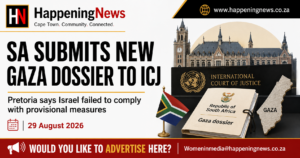
On 25 August 2026, South Africa submitted another substantial dossier of information to the ICJ concerning what it describes as Israel’s non-compliance with the provisional measures
HappeningNews has more on South Africa’s latest [Gaza dossier submitted to the ICJ] and what Pretoria says it contains..
DIRCO said the dossier was intended to assist a committee of judges examining information supplied by the parties about implementation of those orders.
South Africa says its actions form part of its commitment to the Genocide Convention and international law.
6. What does Israel say?
Israel categorically rejects South Africa’s genocide allegations.
Its legal position is that its military action is directed against Hamas rather than the Palestinian population and that it is exercising its right to defend its citizens following the attacks of 7 October 2023.
Israel argues that genocide requires a specific intent to destroy a protected group and says that this intent is absent from its actions.
It has also argued before the Court that it takes measures intended to reduce civilian harm and facilitate humanitarian assistance, while accusing Hamas of operating from civilian areas and using civilian infrastructure for military purposes.
Israel has repeatedly described South Africa’s genocide accusation as false and says its military operations are governed by international humanitarian law.
These remain Israel’s arguments; whether South Africa ultimately proves its case is for the ICJ to decide.
The South Africa Israel ICJ Case is therefore likely to remain before the Court for several more years.
7. What happens next in the South Africa Israel ICJ Case?
The main proceedings are likely to continue for several more years.
South Africa filed its detailed Memorial in October 2024.
Israel filed its response in March 2026 and raised objections concerning the Court’s jurisdiction.
In May 2026, the ICJ set new deadlines for a further round of written arguments.
South Africa has until 22 November 2027 to file its Reply to Israel’s written pleading.
Israel will then have until 22 May 2029 to file its Rejoinder.
This means a final judgment on the merits of the genocide case is not imminent.
Why this distinction matters
Reporting on the South Africa Israel ICJ Case requires particular care because the proceedings are politically charged and legally complex.
Statements such as “the ICJ ruled that Israel is committing genocide” would be inaccurate at this stage.
The Court has ordered legally binding provisional measures and has allowed the proceedings to continue, but it has not yet reached the final question of whether Israel has violated the Genocide Convention.
Likewise, Israel’s rejection of the allegations does not itself determine the outcome. South Africa must establish its case through the legal proceedings and Israel is entitled to present its defence.
That process is ongoing.
For readers following developments in Gaza, understanding the difference between allegations, provisional measures and a final judgment is essential.
The next years of the South Africa Israel ICJ Case will involve further written arguments and potentially oral hearings before the judges eventually deliver their judgment.
As the South Africa Israel ICJ Case develops, future court filings and hearings will provide further clarity on the arguments presented by both countries.
Until then, HappeningNews will continue distinguishing carefully between what South Africa alleges, what Israel argues, and what the International Court of Justice has actually decided.
Verified primary sources
The official ICJ case page contains the applications, orders, written proceedings and procedural history.
View the official ICJ case file
South Africa’s Presidency provides the latest timetable for the next written pleadings.
Read the Presidency’s June 2026 update
Israel’s official international-law portal contains its submissions and arguments before the Court.