

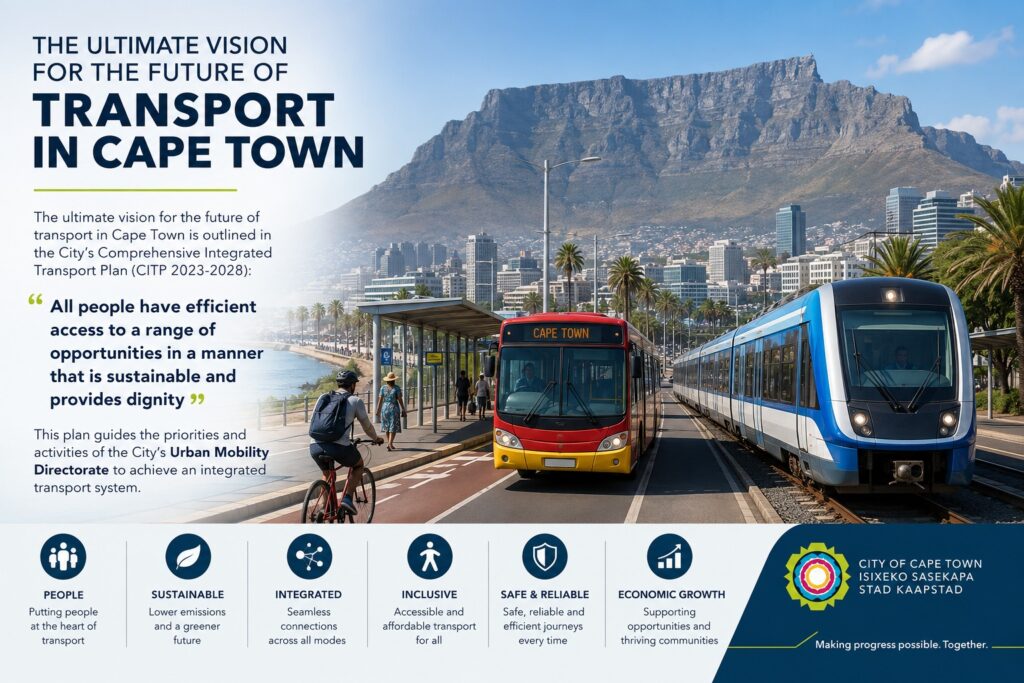
The ultimate vision for the future of transport in Cape Town is outlined in the City’s Comprehensive Integrated Transport Plan (CITP 2023-2028): “All people have efficient access to a range of opportunities in a manner that is sustainable and provides dignity”. This plan guides the priorities and activities of the City’s Urban Mobility Directorate to achieve an integrated transport system.
A draft update (2026) to supplement the CITP has now been completed and the City would like residents to review the draft and submit their input on this guiding document for transport planning before 30 September 2026.
The City has recently developed a second update to the CITP which considers the current and future state of transport in Cape Town. The latest thinking and developments in the draft update address the need for the following:
- A diagnosis of the central transport problem in the city, which is articulated in a transport strategy
- An updated plan to integrate public transport, walking and cycling
- Strengthening mechanisms to enable spatial restructuring of urban areas to improve efficiency and accessibility
Some examples of new information, and updates to the various transport strategies include:
- The updated data on the current transport services and related demographic information in Cape Town
- An updated transport needs assessment
- The Council-approved, updated Integrated Public Transport Network (IPTN) Plan 2040
- The guiding policy of the transport infrastructure strategy
- The Council-approved, new Walking and Cycling Strategy
- The Council-approved, updated Freight Management Strategy
- The Council-approved, updated Travel Demand Management Strategy
‘For our City to be prosperous and inclusive, our people need to be able to move freely and efficiently every day to make a living and to have access to various opportunities whenever they need. Our overall analysis concludes that all modes should be adequately accommodated, in particular walking and cycling should be supported. The future motorised travel demand must be accommodated through a well-designed and optimised public transport network with rail as the backbone of the network and carrying the highest public transport modal share. The capacity of road-based public transport services must also be maximised along the more significant travel corridors with the introduction of priority public transport lanes,
‘The City puts people at the centre of its transport planning. We need to support people to make good travel choices which are environmentally sustainable and support the economy. This update does this through improved public transport; improved conditions for walking and cycling; improved public transport nodes and improved urban centres. Our aim always being to keep Cape Town moving safely and efficiently,’ said the City’s Mayoral Committee Member for Urban Mobility, Councillor Rob Quintas.
The update (2026) tells us how Capetonians commuted in the 2024/2025 period:
- About 35% of all trips are made using public transport
- 55,2 % use private vehicles, which translates into 2 314 000 trips
- 22,5% use minibus-taxis, which translates into 945 000 trips
- 3,2% use trains, which translates into 133 000 trips
- 9,6% walk / cycle (as a main mode)
- 7,1 % make use of bus services such as GABS and MyCiTi
- 2,4 % use metered and e-hailing taxis.
To see how the City plans to encourage a shift towards a more balanced modal share, and greater use of public transport, walking and cycling, please refer to the summary of the Overall Network Design and Commuter Rail Plan updates that are provided in the Public Transport Plan update. These two parts of the Public Transport Plan have had substantial updates based on the updated IPTN Plan 2040. The high-level takeaways from the updated IPTN Plan 2040 include a new way of planning in a context of uncertainty futures. This required extensive scenario planning of supply and demand, which resulted in a ‘low regrets investment network’ (LRN), which identified the travel routes needed under all scenarios. The IPTN Plan 2040 also includes an Implementation Strategy.
The Public Transport Plan includes the City’s support of Prasa’s efforts to recover the rail service, which should be the backbone to an integrated public transport system. Council approved the Cape Town Rail Feasibility Study Business Plan. The IPTN Plan includes and supports the medium- and long-term rail network plan.
At a more local scale, various efforts focus on ensuring that neighbourhoods and major destinations are highly walkable.
How to comment:
• Residents and interested parties are encouraged to submit comments from 1 September to 30 September 2026
• Submit comment via https://www.capetown.gov.za/City-Connect/have-your-say/issues-open-for-public-comment
• Send an email to Comprehensive.IntegratedTransportPlan@capetown.gov.za
• Submit written comments at any library, Subcouncil office, or the Public Transport Office, (opposite the Tower Block lifts), 2nd Floor, Cape Town Civic Centre, 12 Hertzog Boulevard, Cape Town
Source: City of Cape Town