

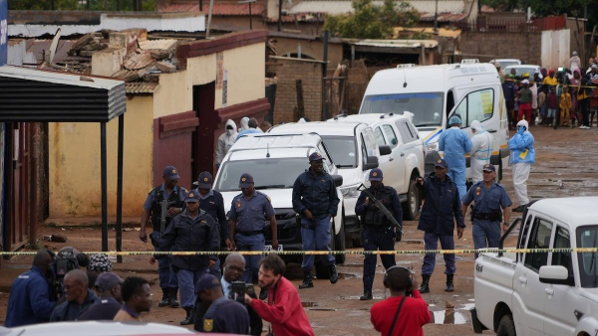
Forty people have died across three mass shootings in South Africa within days, putting renewed focus on illegal firearms, crime intelligence and the ability of authorities to prevent heavily armed attacks.
The killings in KwaMakhutha in KwaZulu-Natal, Wedela in Gauteng and Lwandle in the Western Cape occurred separately, with no evidence currently establishing a connection between all three.
But their proximity in time, and the scale of the bloodshed, has forced a broader question into focus: when mass shootings occur repeatedly, how does South Africa stop extreme violence from becoming something communities simply learn to expect?
Table of Contents
Three Mass Shootings in 40 Days
The first of the three attacks occurred in KwaMakhutha, south of Durban, where armed men entered a homestead in the Ziko area and opened fire on a gathering of 14 people.
The death toll later rose to 12 after one of three people who had been hospitalised died from their injuries. Police have not ruled out gang rivalry as a possible motive.
Days later, two more mass shootings unfolded within hours of each other.
In Wedela, near Carletonville on Gauteng’s West Rand, gunmen armed with AK-47 rifles and pistols opened fire on people inside and outside a tavern. The death toll, initially reported at 17, later rose to 18.
Police said eight armed suspects were being sought.
Investigators are also examining whether the massacre could be connected to an earlier shooting at the same tavern. Gauteng Deputy Police Commissioner Fred Kekana said police had information about the suspected attackers and were investigating possible retaliation between groups.
Hours later, another mass shooting unfolded at a shisanyama in Lwandle near Cape Town.
Ten people were killed and 11 others wounded after gunmen opened fire at the venue. Police launched a search for those responsible as investigators worked to establish a motive.
Across the three crime scenes, 40 people lost their lives.
Where Are the Illegal Guns Coming From?
The attacks have pushed another question beyond the individual crime scenes: how are criminals gaining access to weapons capable of causing such devastation?
Crime and justice expert Professor Jacob Mofokeng of the Tshwane University of Technology has linked the proliferation of illegal firearms in South Africa to weaknesses in border control and crime intelligence.
Mofokeng told EWN that the true number of illicit firearms circulating in South Africa remains unknown.
He pointed to criminal networks moving firearms across the country’s borders, arguing that an under-resourced border management system, combined with demand from criminal groups, has helped an illegal market flourish.
The use of automatic rifles in mass shootings, he argued, points to an oversupply of firearms available to criminals.
Wedela provides a stark example: police say the attackers there were armed with AK-47 rifles and pistols.
The question is therefore no longer only who pulled the trigger, but how such weapons are reaching criminal groups in the first place, and whether they can be intercepted before they reach another crime scene.
When Extraordinary Violence Starts Feeling Familiar
South Africa’s latest mass shootings have also landed against an already severe backdrop of violent crime.
More than 22,700 people were murdered in the country during the 12 months to the end of June, according to police data cited by The Guardian.
The latest attacks add another dimension to that reality.
For families and communities, particularly younger generations growing up around repeated reports of shootings and murders, the issue extends beyond the individual perpetrators.
It raises a difficult question: what kind of South Africa are children inheriting if extreme violence becomes increasingly familiar?
The three shootings alone cannot answer that question, and they should not be treated as evidence of a single coordinated wave of violence.
But 40 deaths across three separate attacks within days make the wider conversation about prevention difficult to avoid.
A mass shooting should be extraordinary. The danger is what happens when another one no longer feels unexpected.
Crime Intelligence Faces Renewed Srutiny
Mofokeng has also questioned the effectiveness of crime intelligence in preventing the movement of illegal firearms.
That concern becomes particularly significant when investigators are already examining possible criminal networks and retaliatory violence in some of the latest cases.
In Wedela, police are investigating whether the tavern massacre may be connected to a previous shooting at the same establishment. Police said one of those killed in the latest attack was allegedly a person they had been seeking in connection with that earlier incident.
In KwaMakhutha, possible gang rivalry has not been ruled out.
These remain separate investigations with different circumstances and possible motives.
However, together they expose a broader challenge: disrupting armed criminal groups and illicit firearm networks before authorities are left responding to another mass casualty scene.
The Investigations Continue, but so does the Bigger Question
Police continue to pursue suspects as investigators work to establish who carried out the attacks and what motivated them.
Those investigations may eventually explain what happened in KwaMakhutha, Wedela and Lwandle individually.
But identifying the gunmen will not, on its own, answer the broader questions raised by a week in which 40 people were killed.
Where are the illegal firearms coming from? Can intelligence identify dangerous networks before they attack? And what happens to communities when mass violence begins to feel less exceptional?
For the families of those killed, those questions come too late.
For the next generation of South Africans, the answers could matter enormously.
Source and References
Also read: South Africa Crime Stats Q1 2026: 5 Critical Trends
South Africa Ranked 7th Globally for Organized Crime as SAPD Infiltration Reaches Critical Levels
https://www.sabcnews.com/sabcnews/death-toll-rises-to-18-in-wedela-tavern-shooting
https://www.ewn.co.za/2026/09/28/cops-searching-for-attackers-responsible-for-deaths-of-27-people-in-2-mass-shootings
https://www.sabcnews.com/sabcnews/police-issue-stern-warning-to-wedela-mass-shooting-perpetrators
Image: Police and forensic teams at the scene of a mass shooting in South Africa. Image supplied.