
It may surprise many to learn that arm wrestling is an international sport — but it does indeed require hard work and good technique, something you definitely cannot learn late one night in a pub…
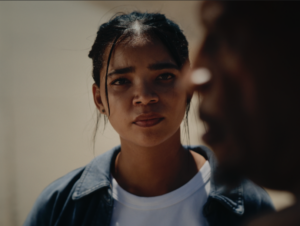
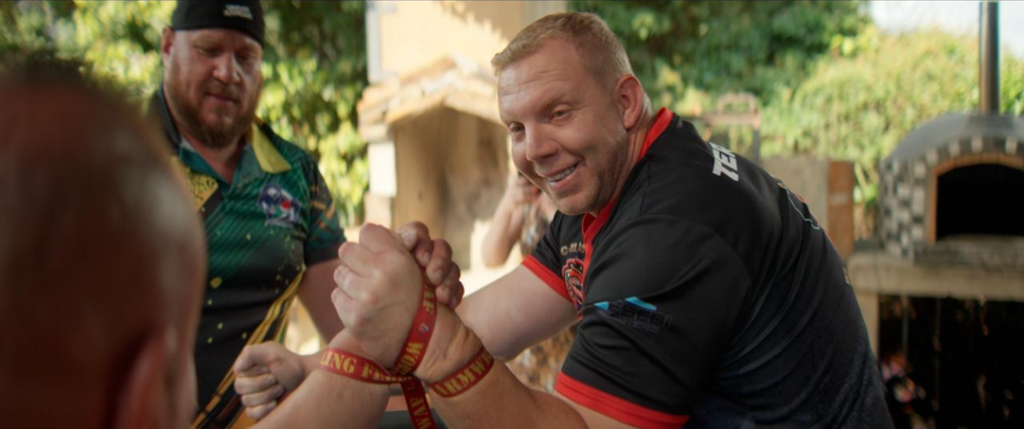
The short documentary Druk dit! lifts the veil and introduces viewers to the arm wrestling community. It focuses especially on Terence Opperman, known as “The Highlander”, a South African champion who gives his opponents a rough time, on the left arm and the right.
Druk dit! makes its debut at the kykNET Silwerskerm Festival, which takes place from 19 to 22 August in Cape Town, and is not merely a story about sport, but about a man who had to face challenges and finally found an outlet in arm wrestling.
Questions for Juandrè de Jager and Lara Lourens, co-directors
Why a film about arm wrestling? (And from two women, at that…) Where does your interest in and/or involvement with arm wrestling come from?
Juandrè (J): I have been part of the arm wrestling community since high school. I competed myself and am also a qualified referee. That is also where the dream began to produce something about arm wrestling.
Lara (L): I have no background in arm wrestling — and after trying it on set, clearly no future in it either… Juandrè was a second-year student at PALI who attended my class, where I taught them how to put a pitch together. She started working on the concept for Druk dit! for her practical assignment, and in her final year at PALI she eventually approached me and Kaz McFadden (our line producer) to pitch the concept to the kykNET Silwerskerm Festival. It was a tremendously interesting concept, so we naturally said yes.
Arm wrestling is indeed a sport and not merely a late-night pub game to test who is the strongest. Please elaborate.
J: Arm wrestling is a national and international sport. There is far more training, technique, and strength involved than outsiders think. On the contrary, it can become very dangerous if you try to test who is the strongest late at night under the influence.
L: When Juandrè originally came up with this story, I had no idea that arm wrestling was such a big sport with so many followers. Going on this adventure with Juandrè opened up a whole new world for me.
It would appear that there are not many arm wrestlers in South Africa. Tell us more about the community and the story of Terence Opperman from eMalahleni.
J: The arm wrestling community is one like few others. They look very intimidating, but they — and Terence — are gentle giants. They are always willing to help, in the community and at a competition alike. Terence is the strongest arm wrestler in the Southern Hemisphere — number one on both left and right. By day he is a plant manager at a mine. He is also a father and a man with a very gentle heart.
L: I learned that arm wrestling is so much more than a sport — it is a community where anyone is welcomed with open arms: salt-of-the-earth people who call a spade a spade, with an extraordinary passion for something that is truly tremendously exciting. Terence introduces viewers to this sport and its people. Together with Terence, we explored his world, and we hope viewers find it just as fascinating as we did.
Is it a difficult sport to film, given that all the action takes place in such a small space?
J: It was somewhat challenging because there was a great deal to take into account, and all the action happened very quickly.
L: This is precisely why I am absolutely in love with documentary films. I come from the world of scripted films and series, but since I made my first documentary last year (Verander, for the Silwerskerm Festival), I have completely lost my heart to it. You face different kinds of challenges — you work with real people whom you have to put at ease so that they feel safe enough to share their stories with the world. You hear fascinating stories, but it is not like fiction where you can simply reshoot if something goes wrong. Once the moment has passed, it is gone. You cannot ask someone to shed a tear again. The same applies to sport — during an arm wrestling match you have one opportunity to capture a moment on camera, which requires a great deal of focus, attention, and running around. It was a fantastic experience and one that will make me smile for years to come.
Tell us more about the other themes that are touched on.
J: People must seize opportunities. Even though Terence lives in a country where professional arm wrestling is relatively underdeveloped and underfunded, he still manages to compete at international level. The documentary also challenges our preconceived ideas about people. We not only explore the iron-armed man’s sporting career, but also show who he truly is as a person. And then there is the surprise of finding a community in an unexpected place. Although it is a highly competitive sport, Terence has also found a community with a close-knit network of participants, supporters, and friends who encourage one another.
L: Terence has overcome various challenges and setbacks — and in the process he has grown and become an inspiration to others. The documentary is about more than an unusual sport — it is also about family, victory, community, and the striving for a better future.
*The 14th kykNET Silwerskerm Festival takes place from 19 to 22 August in Camps Bay, Cape Town. Tickets for the films, as well as the prestigious awards ceremony on Saturday, 22 August, are available at Quicket.
For the full programme, visit www.silwerskermfees.co.za.